
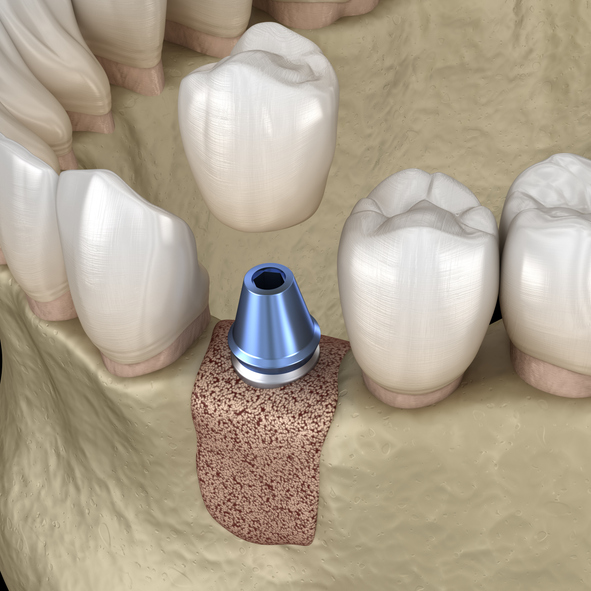
The socket collapses, and your options narrow. If you skip the bone graft after a tooth extraction, the bone that held your tooth starts to shrink, with most of the change in the first few months. That does not rule out a future dental implant. It often makes your path to one longer, more involved, and more costly than it needed to be.
What Happens to Your Socket in the First 6 to 12 Months
Your jawbone is there to hold your teeth. When a tooth is removed, your body senses that the bone around it no longer has a job, and it starts to resorb, or shrink. This can begin almost right away.
Here is what that looks like in real numbers. Without a graft, the ridge can lose up to half of its width in the first year, and about two-thirds of that loss typically happens in the first three months. Height usually changes less than width.
A few details explain why this matters to you:
- Width goes first, and width is what an implant needs. An implant has to sit inside the bone with healthy bone left on the cheek side and the tongue side. A ridge that has lost half its width may no longer have room.
- The cheek-side wall is the most fragile. The outer wall of the socket is thin and easily lost, so the ridge tends to cave in from the outside and leave a hollow.
- New bone fills the socket, but not all the way. The socket does heal with new bone, yet that bone never climbs back to the level of the teeth beside it.
None of this is anyone’s fault. It is simply how extraction sites heal when nothing is placed in them.
How a Collapsed Ridge Changes Your Options Later
A thinner ridge does not close the door on replacing your tooth. It changes what each option asks of you, and the longer a site goes without a tooth, the more bone tends to be lost.
- A dental implant may need a separate rebuilding step first, such as ridge augmentation or guided bone regeneration. In the upper back jaw, lost height can mean a sinus lift. Each of these is its own procedure with its own healing time, often three to nine months depending on the size of the area and the material used. Only then does your implant go in, followed by the healing period before your crown.
- A bridge can still be made, but a sunken ridge can make the replacement tooth harder to blend in. Your periodontist may suggest soft tissue ridge augmentation to rebuild the gum contour so the bridge looks natural.
- A removable partial denture rests on top of the ridge rather than stimulating it, so the bone underneath tends to keep receding over the years.
If you are already past the extraction, please do not let this worry you. Rebuilt bone can support implants very well. Implants placed in rebuilt bone have long-term success rates that compare favorably with implants placed in natural bone. If you would like to know where your own site stands, we explain how bone is measured in Do I Need a Bone Graft Before a Dental Implant?
Why It Matters Most for Your Front Teeth
If you are losing a front tooth, this is where the graft decision carries the most weight. In the front of your upper jaw, the bone wall on the lip side of each tooth is usually very thin. In most people it is less than 1 mm thick, and in many it is less than half a millimeter.
Thin bone disappears quickly. When that wall is 1 mm or thinner, the lip side of the socket can lose more than half of its height within about two months of the extraction. Thicker walls tend to lose far less.
Here is why that shows in your smile. Your gums take their shape from the bone beneath them. When the lip-side bone is gone, the gumline around your new tooth may no longer match the teeth beside it, and a hollow can form where the ridge caved in. Missing lip-side bone is one of the main reasons a front-tooth replacement can look less natural than the teeth around it.
One more thing to know: after an extraction, the gum over a thin-walled site can thicken on its own. That can make the area look healthy even when bone underneath is missing, which is one reason we rely on 3D imaging rather than appearance alone.
Socket Preservation Now vs. Major Grafting Later
This is the heart of the decision. The same missing tooth can call for a small preventive step today or a larger rebuilding procedure later.
| Path | When it happens | Separate procedure? | Added healing time | What it does |
|---|---|---|---|---|
| Socket preservation | At your extraction visit | No | Little, since it heals during the wait you already have | Keeps the bone you have |
| Rebuilding the ridge later | After the ridge has shrunk | Yes | Often 3 to 9 months before your implant | Rebuilds bone you have lost |
A graft does not freeze your socket in place, and some change still happens. It does limit that change in a meaningful way. On average, a graft preserves about 2 mm more width and height than healing on its own, and it lowers the chance you will need additional grafting when your implant is placed.
Is a Socket Graft Just an Upsell?
We understand why it can feel that way. You came in to have a tooth removed, and now there is another line on your treatment plan. That is a fair question, and you deserve a straight answer.
A socket graft is less about adding treatment and more about the order of treatment. If an implant is anywhere in your future, the bone has to be there when the implant goes in. You can keep it now, during a visit you are already having, or rebuild it later with a separate procedure and a longer wait. The window right after an extraction is the simplest and least expensive moment to protect bone.
It is also not needed for every extraction, and we will tell you when it is not. Ask us to walk you through your scan and explain why a graft is, or is not, part of your plan. Insurance coverage varies, and some plans partially cover bone grafting when it is considered medically necessary. Our team can review the specifics with you before treatment.
When Skipping the Graft Is Reasonable
Socket preservation is not necessary for every extraction. If the tooth sits in an area that does not affect your bite or your future cosmetic plans, you may reasonably decide against it. A few common examples:
- You do not plan to replace the tooth. Many wisdom teeth, and teeth removed to make room for orthodontic treatment, fall into this group.
- Your implant can go in the same day. When bone quality allows, an implant can sometimes be placed at the time of the extraction, which changes the plan entirely.
- You have chosen a different path. Some patients opt for a removable partial denture or decide to leave the space open. That is your choice to make, and knowing the ridge will likely keep changing helps you make it with clear eyes.
If an implant might be in your future, even years from now, we gently encourage you to talk with us before the tooth comes out. The decision is easiest to make while the socket is still open.
Talk With Us Before Your Tooth Comes Out
If you have been told you need an extraction, or you are weighing whether a socket graft is worth it, we would be glad to help you think it through. Dr. Godat, Dr. King, and Dr. Byakina are board-certified periodontists and dental implant surgeons. They will review your imaging with you, talk about where your smile is headed, and give you an honest recommendation for your situation. Dr. Godat and his partners have placed over 29,000 dental implants, so we know how much a strong foundation matters.
Call (901) 761-3770 or request an appointment at our Memphis or Collierville office.