
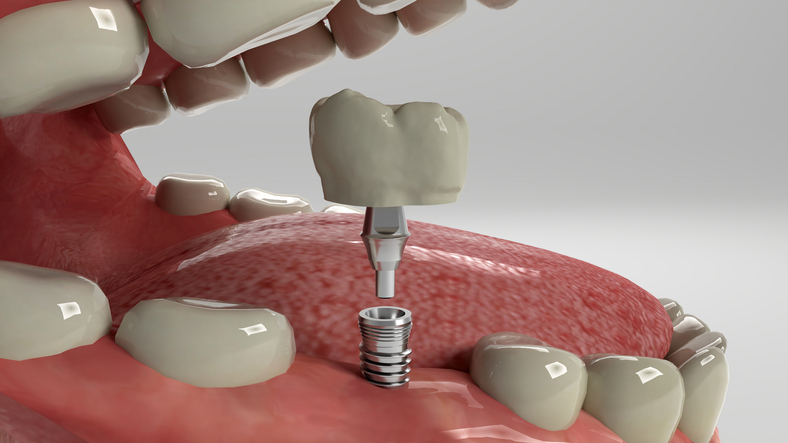
Patients ask us some version of the same question almost every week: can I just get the implant now and deal with my gums later?
Yes, you can get dental implants if you have gum disease. But not while the infection is still active.
That distinction matters more than almost anything else in implant dentistry. An implant placed into an infected mouth goes into the exact bacterial environment that destroyed the tooth it is replacing. Treat the disease first and implants become one of the most predictable procedures in dentistry, with success rates in the mid-90s over ten years. Skip that step and you are gambling with bone you cannot easily get back.
Why Active Gum Disease Disqualifies You (For Now)
Periodontal disease is a bacterial infection of the tissue and bone holding your teeth in place. The bacteria live in periodontal pockets, the deepened space between gum and tooth, and they do not stay put.
That creates three problems. First, deep pockets around your natural teeth act as a reservoir: the bacterial species found in untreated pockets are the same ones later found colonizing failing implants. Second, periodontitis destroys the bone volume and density an implant needs, so a fixture placed in resorbing bone has poor stability from day one. Third, osseointegration is a healing event, and chronic inflammation interferes with healing.
There is also a longer-term concern: peri-implantitis. It is the implant equivalent of gum disease, an inflammatory condition causing progressive bone loss around an implant, and it is the leading cause of late implant failure. Studies estimate it affects roughly one in five implant patients, and a history of periodontal disease is among the strongest known risk factors.
The Treatment Sequence, With Real Timeframes
These intervals are not padding. Each one exists because tissue needs a specific amount of time to do something.
Step 1: Comprehensive Periodontal Evaluation (Visit 1, 60 to 90 minutes)
Full-mouth probing with six measurements per tooth, radiographs, and in most implant cases a CBCT scan to map bone height, bone width, and the position of the sinus and inferior alveolar nerve. We stage and grade the disease and review your medical history, including diabetes control and smoking. This is also the visit where we tell you honestly whether a questionable tooth is worth saving.
Step 2: Infection Control (Weeks 1 to 6)
For mild to moderate disease, scaling and root planing over one to two appointments. For advanced disease, LANAP laser therapy in two sessions about a week apart, or osseous surgery to reshape bone and eliminate deep defects. Hopeless teeth come out during this phase, and we usually pair extraction with socket preservation grafting in the same appointment.
Step 3: The Healing Interval (4 to 8 weeks, or 8 to 12 after surgery)
The step patients most want to skip, and the one we will not compress. Tissue needs four to six weeks after scaling and root planing for inflammation to resolve and the gum to reattach to the cleaned root surface, or eight to twelve weeks after osseous surgery. Probing too early gives a falsely optimistic reading, because inflamed tissue is swollen and the numbers change as that swelling resolves.
Step 4: Re-Evaluation
We re-probe the entire mouth against baseline. Before implant planning proceeds, we want probing depths of 4 mm or less, bleeding on probing under about 10 to 15% of sites, no suppuration anywhere, and home care that has genuinely changed. If those targets are not met, we re-treat and re-evaluate rather than move forward. Needing a second round is a normal outcome, not a failure.
Step 5: Bone Grafting, If Needed (3 to 9 months)
Details below. What matters is the placement in the sequence: after infection is controlled, before the implant goes in.
Step 6: Placement and Integration (3 to 6 months to restoration)
Implant placement is typically 60 to 90 minutes per implant, with sedation available. Osseointegration takes three to four months in the lower jaw and four to six months in the upper jaw, where bone is less dense. Immediate protocols like Teeth-in-a-Day and All-on-4 can compress this, but they require strong primary stability, which is exactly what advanced gum disease takes away.
Realistic total: six to eighteen months from first evaluation to final crown.
Where Bone Grafting Enters the Picture
Gum disease destroys bone, so many patients arrive with too little to support an implant. What you need depends on what was lost.
- Socket preservation, heal 3 to 4 months. Done at the same appointment as extraction, packing graft material into the socket so the ridge does not collapse. This is the single most valuable thing we can do for a future implant, and the reason we prefer to handle extractions ourselves rather than see a collapsed site months later.
- Ridge augmentation, heal 4 to 6 months. For ridges that already collapsed and are too narrow or too short to house an implant.
- Sinus lift, heal 6 to 9 months. Upper back teeth sit directly beneath the maxillary sinus, and when they are lost to gum disease the remaining bone height is often only a few millimeters.
- Guided bone regeneration, no additional wait. Minor defects can be grafted at the same surgery as placement.
More on bone grafting and bone preservation and regeneration.
What Happens If You Skip Ahead
- Early failure. The implant never integrates, stays mobile, and comes out within months. You lose the fee, the time, and more bone than you started with.
- Late failure through peri-implantitis. More common and more insidious. Everything looks fine for a year or three, then bleeding starts and bone disappears on radiographs. By the time it hurts, the loss is significant. The implant surface is textured to encourage bone attachment, which also makes it hospitable to bacteria and very hard to decontaminate.
- Compounding loss. Removing a failed fixture takes bone with it, so a second attempt almost always requires grafting and a long wait.
- Paying twice. The cheapest implant is the one that works the first time. See our page on the cost of dental implants.
Long-Term Maintenance After a Periodontal History
Treated periodontal patients do very well with implants, but the risk of peri-implantitis stays with you, and that changes what maintenance looks like.
- Three-month recall, not six. Periodontal maintenance at 90-day intervals is the standard of care after periodontal therapy, timed to how quickly subgingival bacteria re-establish. Compliance is one of the strongest predictors of long-term implant survival.
- Implants get probed too. We check depths and bleeding around your implants at every visit and take periodic radiographs against your baseline. Caught at the reversible mucositis stage, peri-implantitis is manageable. Caught late, it often is not.
- Cleaning between them is non-negotiable. Implant crowns are contoured differently than natural teeth, so most patients need interdental brushes, a water flosser, or floss threaders rather than string floss alone.
- Smoking and diabetes matter enormously. Both significantly raise peri-implantitis risk. If you smoke, this is a genuinely good moment to stop.
- Call about changes. Bleeding when you brush around an implant, tenderness, a bad taste, or a crown that feels different are all worth a call. Early intervention is straightforward.
Talk to a Memphis Periodontist
Dr. Mitchel S. Godat, Dr. Grant T. King, and Dr. Olga Byakina are board-certified periodontists and implant surgeons who have placed more than 29,000 implants between them. Gum disease and implant dentistry are not two specialties to us, which is why this entire sequence happens under one roof.
If you have been told you are not a candidate because of gum disease or bone loss, that may have been a not yet rather than a never. Review whether you are a candidate for implants, or request an appointment at our Memphis or Collierville office.
Frequently Asked Questions
Can you get dental implants if you have periodontal disease?
Yes, but the disease must be treated and stabilized first. Implants placed during active infection fail at substantially higher rates. Most patients complete periodontal therapy, heal four to eight weeks, and pass a re-evaluation before implant planning begins.
How long after gum disease treatment can I get implants?
Four to eight weeks at minimum after non-surgical therapy. Add three to nine months if bone grafting is required, depending on graft type. Most patients starting with active disease are looking at six to eighteen months from first visit to final crown.
Will gum disease come back around my implants?
The implant itself cannot get gum disease, but the surrounding tissue and bone can develop peri-implantitis, which behaves similarly. A periodontal history raises that risk, which is why three-month maintenance matters so much.
Can I get implants if I have already lost bone from gum disease?
Usually yes. Socket preservation, ridge augmentation, and sinus lift procedures rebuild the volume needed. A CBCT scan at your consultation shows exactly how much bone you have and what needs to be added.